The physical world is described here Raksha Bandhan Rakhi

as a tree with its roots facing upwards and its branches facing downwards. We have the experience of a tree with its roots facing upwards. When a person stands on the bank of a river or a pond, he sees the trees reflected upside down in the water. The branches face downwards, and the names are different. Similarly, this physical world is a reflection of the spiritual world. The physical world is only a reflection of the truth. Reflections are neither the truth nor the essence. There is no water in the desert, but the illusions give the impression that there is water. There is no water in the physical world, there is no joy. But the real water of real joy is in the spiritual world.

God wants us to attain the spiritual world in the following way:

He teaches (Bhagavad Gita 15.5):

The delusion of creation, the delusion of spiritual self-deception

Only through a person who is “infatuated with creation” can that “word is inexhaustible” i.e. the eternal world be reached. What does this mean? We run after the positions. One wants to be called “Aiya”, one wants to be a lord, another wants to be the president of the country or a rich man or a king or something else. As long as we are interested in these positions, it is as if we are interested in the body. Because all these positions belong to the body. But we are not this body. To experience this is the first stage of spiritual realization. We are composed of the three modes of nature. But through the service of the Lord, we have to become free from them. If we are not attached to the service of the Lord, we cannot become free from the modes of nature. Positions arise only because of attachment, lust, desire, that is, because of our desire to dominate nature. Until one gives up the desire to dominate material nature, one cannot attain the eternal state of the Lord.

who is thus situated reaches the ultimate abode very easily.

It is said elsewhere in the Bhagavad Gita (8.21):

The ineffable is the past.

If we attain the goal, then we will attain the ultimate goal.

“Unmanifest” means unmanifest. The entire material world is unmanifest before us. Our senses are so imperfect that we cannot see even all the stars in this material universe. In the Vedasarasvatam we can get a lot of information about all the worlds. We can believe it or not. All the important worlds are described in the Vedasarasvatam, especially in the Srimad Bhagavatam. The spiritual world, which is beyond this material space, is described as unmanifest, that is, unmanifest. Man should desire and strive to attain that ultimate abode. Because when he attains that abode, he will not need to come back to this material world.

Now, someone may raise the question of how a person can attain that divine state. The information about that is given in the eighth chapter. There it is said:

I will remember forever and ever, and I will be free from all bondage. I will travel with my mind in a state of mind that is not subject to any harm.

“Whoever, at the end of his life, remembers Me alone and leaves his body, immediately attains My consciousness. There is no doubt about that” (Bhagavad Gita 8.5). One who thinks of Krishna at the time of death reaches Krishna. One should remember the form of Krishna. If he remembers that form and leaves his body, he will certainly reach the abode of God. The word “madbhava” refers to the supreme nature of the Supreme Personality of Godhead. The Supreme Personality of Godhead is the image of Sachchidananda. That is, His form is eternal, full of knowledge, full of bliss. Our present body is not Sachchidananda. It is neither Asat nor Sat. That is, it is not eternal, perishable. It is not Chit (full of knowledge), and moreover, it is full of ignorance, and we have no knowledge of the spiritual world.


✨ IMAGE PROMPT
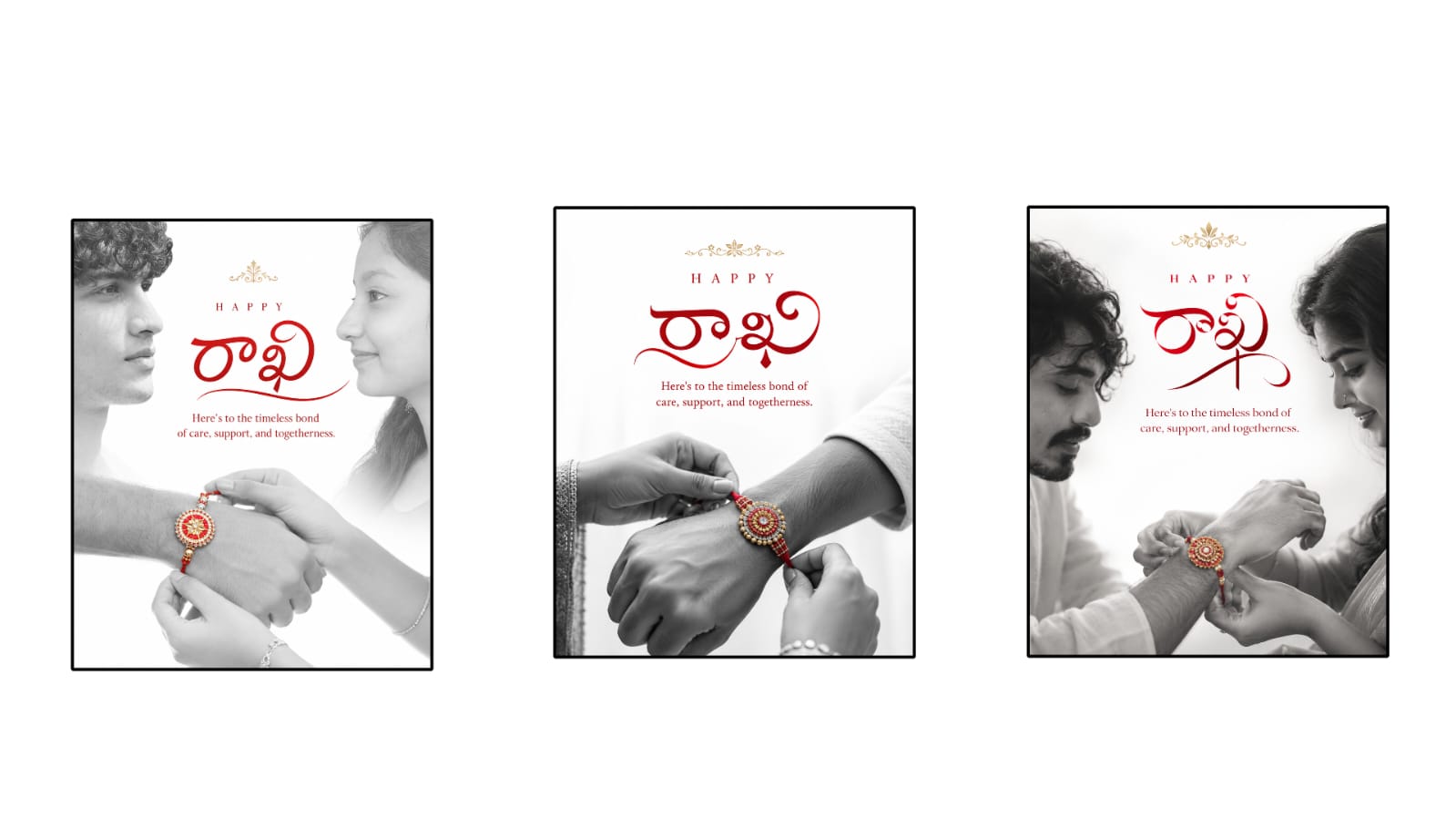
A Uploaded image Create an elegant Raksha Bandhan greeting brother sister in a clean, premium Indian aesthetic. Use a predominantly white background with generous negative space. At the top center, place a small delicate golden ornamental floral motif. Below it, add the words “HAPPY” in widely spaced uppercase red serif lettering. In the center, feature the telugu calligraphy “రాఖి” in bold, flowing, artistic red Devanagari lettering, with elegant sweeping strokes and a refined traditional style. Beneath the calligraphy, add the message: “Here’s to the timeless bond of care, support, and togetherness.” in an elegant red serif font, centered and clearly readable. In the lower half, show a close-up black-and-white photograph of a brother’s wrist while a sister gently ties a traditional Rakhi around it. Keep the hands and arms monochrome grayscale, while the Rakhi remains selectively colored in rich red, gold, and silver, creating a striking focal point. The Rakhi should look intricate and handcrafted, with red threads, gold detailing, and a circular decorative centerpiece. Composition should feel emotional, sophisticated, minimal, festive, and luxurious, with soft natural lighting, realistic skin texture, high photographic detail, balanced typography, and a professional greeting-card layout. Vertical portrait format, high resolution, photorealistic hands, no extra text, no watermark.

✨ IMAGE PROMPT
A Uploaded image Create an elegant Raksha Bandhan greeting brother sister in a clean, premium Indian aesthetic. Use a predominantly white background with generous negative space. At the top center, place a small delicate golden ornamental floral motif. Below it, add the words “HAPPY” in widely spaced uppercase red serif lettering. In the center, feature the telugu calligraphy “రాఖి” in bold, flowing, artistic red lettering, with elegant sweeping strokes and a refined traditional style. Beneath the calligraphy, add the message: “Here’s to the timeless bond of care, support, and togetherness.” in an elegant red serif font, centered and clearly readable. In the lower half, show a close-up black-and-white photograph of a brother’s wrist while a sister gently ties a traditional Rakhi around it. Keep the hands and arms monochrome grayscale, while the Rakhi remains selectively colored in rich red, gold, and silver, creating a striking focal point. The Rakhi should look intricate and handcrafted, with red threads, gold detailing, and a circular decorative centerpiece. Composition should feel emotional, sophisticated, minimal, festive, and luxurious, with soft natural lighting, realistic skin texture, high photographic detail, balanced typography, and a professional greeting-card format, high resolution, photorealistic hands, no extra text, no watermark. 4:5 and last light close up side profile brother sister face reveal opacitive face 50%
  • Related Posts

    It is working. “Mayadhyakshena prakrutih 180

    suyate sacharacharam – nature is working under my direction,” said Lord Krishna. When we see wonderful things happening in material nature, we must know that there is a controller behind…

    Viral Trending part 2 Epic Reel Editing 178

    You might wonder why we need this shape. This shape works like a mask layer. Go to ‘Blending’, then ‘Mask’, and apply the mask. Now look—like this, like this, like…

    Leave a Reply

    Your email address will not be published. Required fields are marked *

    You Missed

    The physical world is described here Raksha Bandhan Rakhi

    The physical world is described here Raksha Bandhan Rakhi

    It is working. “Mayadhyakshena prakrutih 180

    It is working. “Mayadhyakshena prakrutih 180

    Viral Trending part 2 Epic Reel Editing 178

    Viral Trending part 2 Epic Reel Editing  178

    Viral Trending Epic Reel Editing 177

    Viral Trending Epic Reel Editing 177

    Professional Photo Editing Workflow for Stunning Results 176 Ayyappa

    Professional Photo Editing Workflow for Stunning Results 176 Ayyappa

    Complete Guide to Modern Photo 175

    Complete Guide to Modern Photo 175