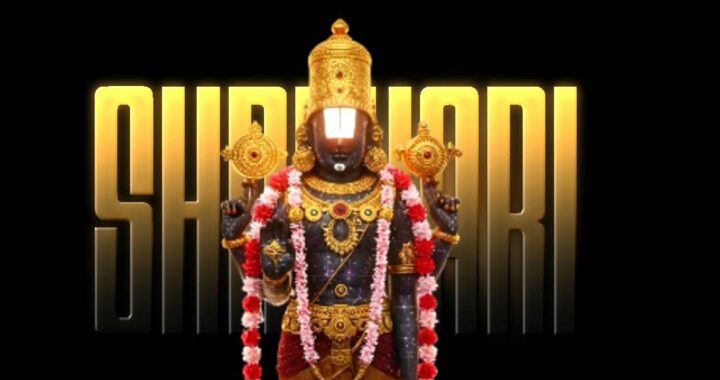
, who said, “I believe in everything you have said.” Therefore, when God says that at the time of death, whoever thinks of himself as Brahma, the Supreme Soul, or God, will definitely enter the spiritual sky, there should be no doubt about it. There is no question of not believing it.
The Bhagavad Gita also lays down the general principle that entry into the spiritual world is possible simply by remembering God at the time of death (8.6).
Explained:
Yam yam vapi smarana bhava tyajatyaste kalevaram | tam tamevaiti kautteya sada tadbhavabhavitah ॥
“O Kaunteya! Whatever feeling a man remembers when he leaves his body, that feeling he will certainly attain.” Now, first of all, we must understand that material nature is a manifestation of one of the divine attributes. In the Vishnu Purana
The divine attributes are explained:
The power of Vishnu is the third power, the knowledge of the field and the knowledge of ignorance and action.
God has infinite and varied powers that are beyond our imagination. However, the great sages, or liberated souls, have studied all those powers and analyzed them into three parts. All those powers are Vishnu powers, that is, they are all powers related to Lord Vishnu. The first power is para (divine). The living entities also belong to para (divine) power. This has already been explained. The other powers, that is, the material powers, are in the mode of ignorance. At the time of death, we may remain in the para (super) power of this material world, or we may attain the power of the spiritual world.
That is why the Bhagavad Gita (8.6) says:
Yam yam vapi smarana bhava tyajatyaste kalevaram | tam tamevaiti kautteya sada tadbhavabhavitah ॥
“O Kaunteya! Whatever feeling a person remembers when leaving his body, that feeling he will surely attain.”
In life, we have to think about physical power or spiritual power.
From anger arises complete delusion. From delusion arises the illusion of memory. When memory is illusioned, intelligence is destroyed. When intelligence is destroyed, man falls back into the abyss of samsara.
Commentary Sri Rupa Goswami has given us this instruction: The worldly mind is connected with the Lord. The renunciation of the worldly mind is the cause of dispassion.
(Bhaktirasamurtisindhu 1.2.258)
By developing Krishna consciousness, one can understand that everything has its use in the service of the Lord. Those who are not in Krishna consciousness try to artificially renounce material objects. As a result, they cannot attain the perfect state of detachment even though they desire liberation from material bondage. On the other hand, a person in Krishna consciousness knows how to use everything in the service of the Lord, and his mere detachment is called vain or insignificant. Therefore, he does not succumb to material consciousness. For example, an immaterialist. In his conception, the Lord (Varatattva) is formless, so he does not eat, and therefore the immaterialist tries to renounce delicious food; whereas a devotee knows that Lord Krishna is the enjoyer of boons and eats whatever is offered to him with devotion. Therefore, after offering good food to the Lord, he accepts the remnants of the food, or prasada. In this way, everything becomes spiritual, and then there is no danger of falling. The devotee takes the food in Krishna consciousness; whereas the nondevotee rejects it as material. Therefore, the immaterialist cannot enjoy life because of his artificial detachment. For this reason, even if the mind is slightly disturbed, it will drag him back into the pit of samsara. It is said that even if such a living entity rises to the stage of liberation, he will fall again because he has no basis in devotional service
Free from hatred of passion, he who is free from the desires of the mind, is free from the desires of the mind.
rāga – attachment; dvesa – aversion; vimukṣyaih – to one who is freed from them; tu – but; viśyayān – sense objects; isrīyaih – by the senses; charan – working